
Intermittent fasting has become one of the most talked-about approaches to weight loss and health.
And yes—it does work.
But not in the way most people think.
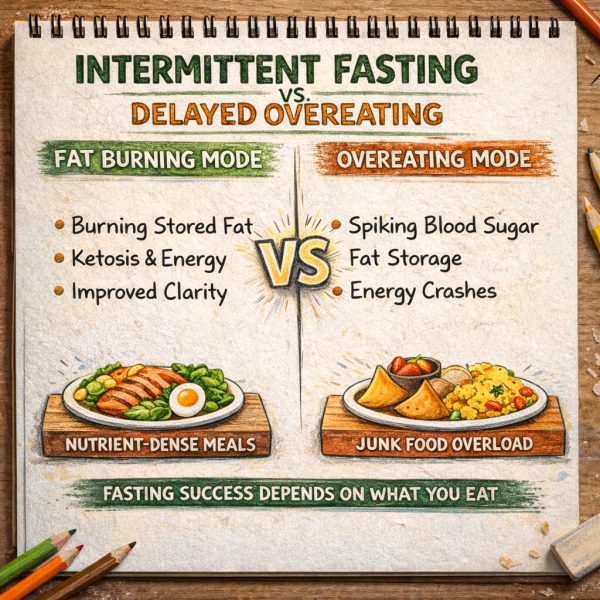
A common misconception is that intermittent fasting (IF) is simply about eating within a smaller time window. People fast for 16 hours, then spend the next 8 hours eating anything and everything—poha, samosas, fried snacks, and processed foods—assuming the fasting alone will deliver results.
It doesn’t.
That is not intermittent fasting.
That is simply delayed overeating.
What Actually Happens During Fasting
When you fast for an extended period, your body undergoes important metabolic shifts:
- It moves into a fat-burning state
- It starts using stored fat as its primary energy source
- It depletes glycogen (sugar) reserves from your last meal
This is the real science behind intermittent fasting.
And when done correctly, the results can be powerful.
People often experience:
- Sustainable weight loss
- Improved insulin sensitivity
- Better energy levels
- Enhanced mental clarity
But these benefits are not automatic. They depend heavily on what you eat during your eating window.
The Most Common Mistake
The biggest mistake people make with IF is assuming that fasting compensates for poor food choices.
It doesn’t.
If your eating window consists of low-quality, high-carb, or heavily processed foods like poha, upma, samosas, or sugary snacks, you are essentially canceling out the benefits of fasting.
Think of it this way:
Your body fasts for 16 hours to reset and optimize.
Then in 8 hours, you undo all of that effort.
Your Eating Window Matters More Than You Think
If you are following a 16:8 routine, you are likely eating two main meals a day.
Those two meals must:
- Provide complete nutrition
- Include adequate protein
- Be rich in fiber, healthy fats, and micronutrients
Because those meals are fueling your entire day.
Intermittent fasting is not about eating less often.
It is about eating better within a structured window.
IF Is Not One-Size-Fits-All
Another important point often overlooked is that intermittent fasting affects individuals differently.
Especially for women, fasting can influence hormonal balance. It is essential to:
- Monitor energy levels
- Track menstrual health
- Adjust fasting duration if needed
There is no “perfect” fasting model.
Whether you choose:
- 16:8
- 5:2
- Alternate-day fasting
The best method is the one that fits your lifestyle and is sustainable long-term.
The Adjustment Phase Is Real
If you are new to intermittent fasting, expect some initial discomfort.
For the first 2 to 4 weeks, you may experience:
- Hunger
- Irritability
- Low energy
This is normal.
Your body is adapting from constant glucose dependence to metabolic flexibility—learning to switch between fuel sources.
Consistency and patience are key during this phase.
Final Thought
Intermittent fasting works.
But only when it builds discipline—not when it becomes another shortcut.
Fasting is just one part of the equation.
The real results come from aligning it with mindful eating and balanced nutrition.
So ask yourself:
Are you actually fasting?
Or just shifting your overeating into a smaller window?