
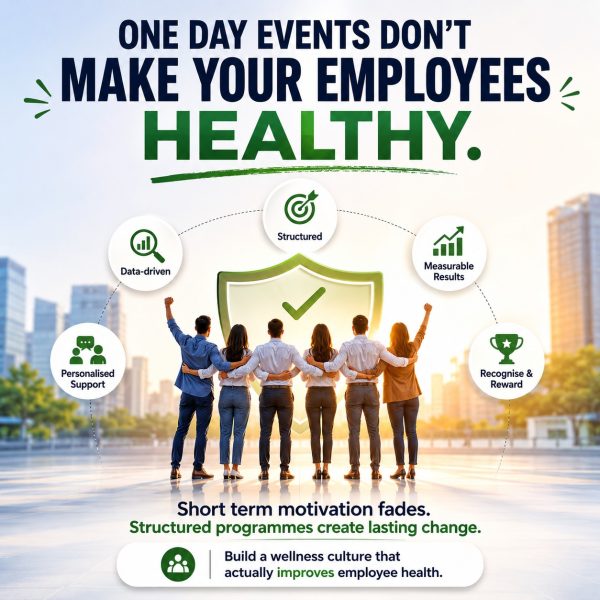
Every year, organizations celebrate Yoga Day, Health Day, Nutrition Week, and various wellness initiatives with enthusiasm.
Employees attend a session, participate in an activity, click a few pictures, and leave feeling inspired.
For a day.
Then reality returns.
Work deadlines take over, healthy habits are forgotten, motivation fades, and within a week most employees are back to their old routines.
This is not because employees don’t care about their health.
It is because motivation alone is never enough.
Real health transformation requires structure, consistency, accountability, and measurable outcomes.
This is the gap that many corporate wellness programs fail to address—and the reason Nutrishilp was built.
The Problem with One-Time Wellness Activities
Single-day wellness events certainly have value.
They create awareness.
They start conversations.
They introduce employees to health concepts they may not have considered before.
However, awareness does not automatically translate into action.
Employees often leave inspired but without a clear plan, regular support, or accountability mechanism to help them sustain healthier choices.
Without follow-up, most wellness initiatives become isolated events rather than catalysts for long-term change.
Organizations invest time and resources, but struggle to see measurable improvements in employee health, energy levels, productivity, or absenteeism.
What Creates Sustainable Employee Wellness?
The most successful corporate wellness programs are not built around events.
They are built around systems.
At Nutrishilp, we focus on creating year-long wellness ecosystems that help employees move from awareness to action and from action to measurable results.
Step 1: Begin with Data, Not Assumptions
Every organization is different.
Before recommending solutions, we first understand the health status of the workforce.
Our wellness engagements begin with comprehensive employee screenings to identify:
- Nutrition-related concerns
- Lifestyle risk factors
- Weight management challenges
- Energy and productivity issues
- Existing health conditions requiring attention
This helps us identify where intervention is truly needed rather than applying generic wellness activities across the organization.
Step 2: Combine Group Learning with Individual Support
Health behavior change happens when education is paired with personalization.
Employees participate in engaging group sessions that focus on motivation, awareness, and practical health strategies.
Alongside these sessions, employees are offered access to one-on-one counselling at subsidized rates.
This allows individuals to receive personalized guidance based on their unique health goals, challenges, and lifestyle.
The combination of collective motivation and individual accountability significantly improves participation and outcomes.
Step 3: Create Multiple Touchpoints Throughout the Year
One session cannot create lasting habits.
Behavior change requires reinforcement.
That is why we conduct four structured wellness touchpoints throughout the year.
Each engagement is designed to:
- Reignite motivation
- Address new challenges
- Review progress
- Introduce practical action plans
- Encourage healthy competition and participation
Every quarter, employees revisit their goals and receive updated recommendations to maintain momentum.
Step 4: Measure the Impact
One of the biggest shortcomings of traditional wellness programs is the lack of measurable outcomes.
At Nutrishilp, we believe wellness should be tracked just like any other business initiative.
Depending on organizational requirements, we conduct:
- Quarterly BMI assessments
- Half-yearly health reviews
- Annual health screenings
- Relevant blood investigations
- Wellness score tracking
Employees receive pre- and post-program wellness assessments, enabling organizations to understand the actual impact of their investment.
When wellness is measured, it becomes easier to improve.
Step 5: Build a Culture of Recognition
People are more likely to sustain healthy behaviors when their efforts are acknowledged.
Recognition transforms wellness from an individual responsibility into a shared organizational value.
One example is our work with BigMint, where wellness became part of the company culture through initiatives such as:
- Step Minter Awards
- High Energy Awards
- Sports Day celebrations
- Wellness-focused recognition programs
These activities were not standalone events but components of a larger, year-long wellness strategy.
The result was increased engagement, stronger participation, and a more health-conscious workplace culture.
From Awareness to Action
The goal of corporate wellness should not simply be to organize events.
It should be to improve employee health outcomes.
That requires a structured framework, consistent engagement, measurable tracking, and ongoing support.
A Yoga Day celebration may inspire employees.
A year-long wellness program can help transform their habits.
And healthier employees contribute to higher productivity, better morale, reduced absenteeism, and stronger organizational performance.
The Bottom Line
One-day wellness events create conversations.
Year-long wellness programs create change.
Organizations that genuinely want to improve employee well-being need to move beyond awareness campaigns and invest in sustainable wellness systems.
At Nutrishilp, we partner with organizations to build structured, measurable, and impactful wellness programs that support employees throughout the year.
If you are an HR leader looking to create a healthier, more engaged workforce, it may be time to think beyond a single wellness day and start building a wellness culture that lasts.