
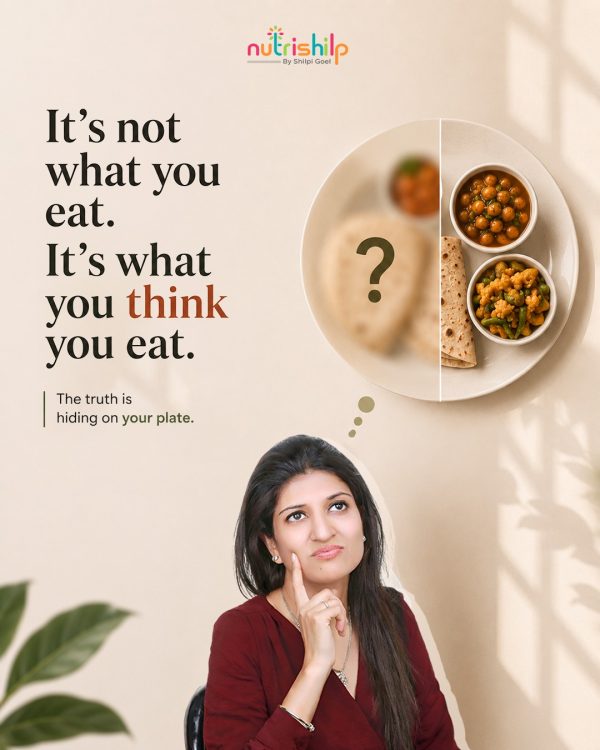
I Hardly Eat Anything. So Why Do I Keep Gaining Weight?”
One of the most common concerns I hear in my clinic is:
“I barely eat anything, yet my weight keeps increasing.”
On the other hand, someone else will say,
“I eat all day, but I still can’t gain weight.”
If this sounds confusing, you’re not alone.
The truth is, weight management is rarely just about how much you eat. More often, it’s about what you’re actually eating, how you perceive it, and how your meals are structured.
The Biggest Nutrition Blind Spot
A 2025 study found that most people misjudge the calorie content of their meals.
Interestingly, this doesn’t happen because people intentionally hide what they eat.
They simply don’t notice certain details.
After years of working with individuals on their health journeys, I’ve realized that these “blind spots” are far more common than people imagine.
The Meal That Looks Healthy—But Isn’t Balanced
Here’s a conversation I have almost every day.
I ask a client,
“What did you have for lunch?”
They reply,
“Roti and sabzi.”
Sounds balanced.
But when I ask what sabzi, the answer is often:
- Paneer Bhurji
- Chole
- Rajma
- Kala Chana
These are nutritious foods, but here’s what many people don’t realize.
Paneer, chole, rajma, and other legumes are primarily protein-rich foods (while legumes also contribute carbohydrates). They are not vegetables.
So instead of eating:
Grain + Vegetable
the meal becomes:
Grain + Protein
While there’s nothing wrong with this combination, it usually contains more calories and less fibre-rich vegetable volume than people assume.
As a result, the meal feels healthy—but it may not provide the balance needed for effective weight management.
Why Vegetables Matter
Vegetables are naturally rich in:
- Fibre
- Water
- Vitamins
- Minerals
- Phytochemicals
They add bulk to your plate without adding many calories.
This helps you feel satisfied while naturally reducing total energy intake.
Research consistently shows that increasing the proportion of vegetables and fibre in meals while moderating portions of calorie-dense foods can improve satiety and support healthy weight management.
It’s Not About Eating Less
Many people think weight loss requires starving themselves.
It doesn’t.
It requires making better food choices.
For example, instead of eating:
- 3 rotis with paneer bhurji
You could try:
- 2 rotis
- Paneer bhurji
- A large serving of mixed vegetables or salad
The meal remains satisfying but becomes far more balanced nutritionally.
Small Changes Create Big Results
One of the most rewarding moments in nutrition counselling is watching someone realize,
“I never noticed this before.”
That’s often the turning point.
Not because we put them on a restrictive diet.
Not because we removed all their favourite foods.
But because we helped them see what had been invisible all along.
Weight management isn’t built on perfection.
It’s built on awareness.
Small improvements repeated consistently create meaningful, lasting results.
The Takeaway
If you feel like you’re eating very little but still struggling with your weight, don’t assume your body is working against you.
Take a closer look at what’s actually on your plate.
Ask yourself:
- Am I including enough vegetables?
- Am I estimating my portions accurately?
- Is my meal balanced, or am I unknowingly doubling up on calorie-dense foods?
- Am I focusing on quality as much as quantity?
The answers to these simple questions can completely change your relationship with food.
At Nutrishilp, we’ve learned that lasting health doesn’t come from extreme diets.
It comes from understanding your everyday habits—and making small, sustainable improvements that fit your life.
Because when you can clearly see your habits, you can confidently change them.