
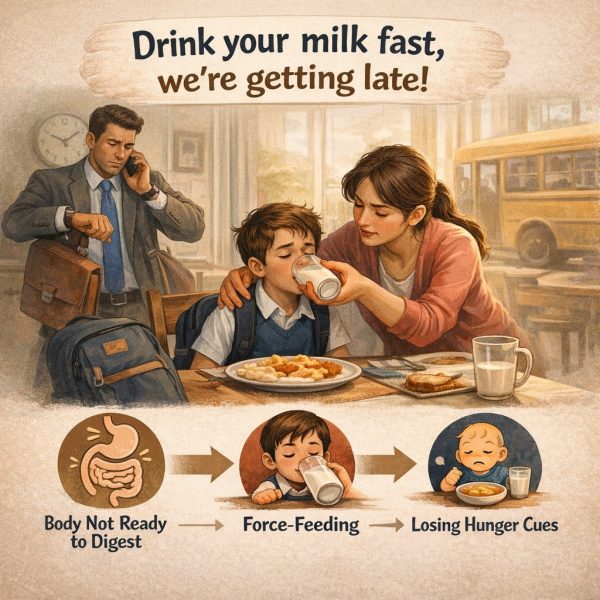
Mornings in most households today look the same—rushed, chaotic, and tightly scheduled. Parents are juggling multiple responsibilities, and in the middle of it all, feeding their child becomes just another task to tick off the list.
And so, without even realizing it, many parents resort to force-feeding.
It usually looks harmless. A quick glass of milk. A few bites insisted upon. A constant “finish this before you leave.” The intention is pure—ensuring the child doesn’t go hungry.
But there’s something important happening inside the child’s body that often goes unnoticed.
When a child wakes up, their digestive system isn’t instantly ready for food. The body is still transitioning from rest mode, focusing on clearing out waste and gradually activating metabolism. This process can take some time.
Yet, in the middle of this natural transition, we introduce food—often forcefully and quickly.
Over time, this creates a subtle but powerful shift.
The child stops listening to their own hunger signals. Instead of eating when they feel hungry, they begin to eat when they are told to. Hunger becomes external, not internal.
And this disconnect doesn’t stay limited to childhood.
As the child grows, it can show up as:
- Poor appetite regulation
- Resistance or anxiety around food
- Overeating in some situations
- Undereating in others
All of this can stem from a pattern that once felt completely normal.
It’s important to understand that the intention behind this behavior is not wrong. Parents simply want to make sure their child is nourished before stepping out for the day.
But feeding out of fear—“What if they stay hungry?”—is very different from feeding with awareness.
What can make a difference is a small shift in approach.
Instead of watching the clock, start observing your child.
Notice their hunger cues. Their energy levels. Their natural pace in the morning. Some children may feel hungry sooner, while others may need more time.
Creating a calm, pressure-free environment around food helps children stay connected to their body’s signals. Even small flexibility—like offering light, easy-to-digest options or allowing a slightly delayed breakfast—can support better eating habits.
Because when a child learns to listen to their body early in life, they carry that awareness forward.
And a body that feels heard grows into a person who knows how to take care of it.